Work

Instruments, vehicle hardware and research — what I built and what I actually did on it.

01

Automated Profilometry System
Mechanical design · Instrumentation · Automation · Metrology — ExpMicroMech, UBC, 2026

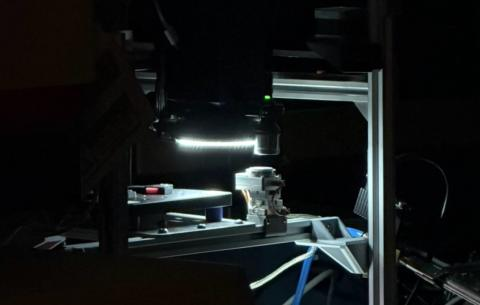
The assembled profilometry system on the optical bench, lit from within
The assembled system: confocal sensor and precision stage integrated into a motorized optical microscope.

Over four months I designed and built an automated profilometry system for UBC's robot-enabled Electron Microscopy Laboratory. It lets a user map the surface topography of a sample and measure how much material has been removed from it — a measurement the lab previously had no direct way to make.

I modelled the components in SolidWorks and wrote a Python control architecture that integrates a confocal sensor and a precision stage into a motorized optical microscope. A Raspberry Pi orchestrates the motion of the camera and interferometer assembly; a Keyence CL-P015 confocal sensor does the topography mapping, with data processed through Gwyddion and linked back to the lab's robot-enabled SEM suite. I designed and manufactured the mounting brackets that hold it all in alignment.

An instrument is only worth as much as its uncertainty budget, so I ran metrology measurement DOEs plus repeatability and reproducibility studies to validate micron-level accuracy before handing it over.
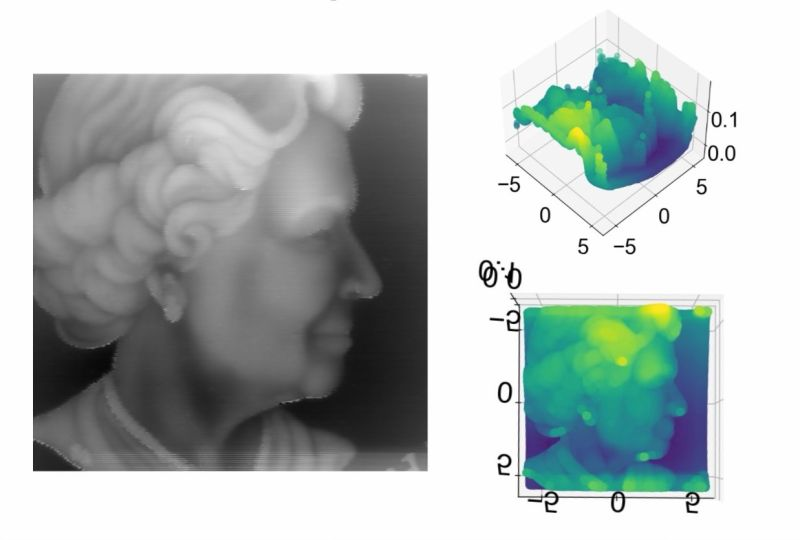
Greyscale topography scan of a Canadian quarter beside two 3-D surface maps of the same coin
A full topography scan and 3-D map of a Canadian quarter — 144,400 points across its surface. 3-D map credit: G. Francolini.

Tools

SolidWorks · Python · Raspberry Pi · Keyence CL-P015 confocal sensor · Gwyddion · DOE & MSA
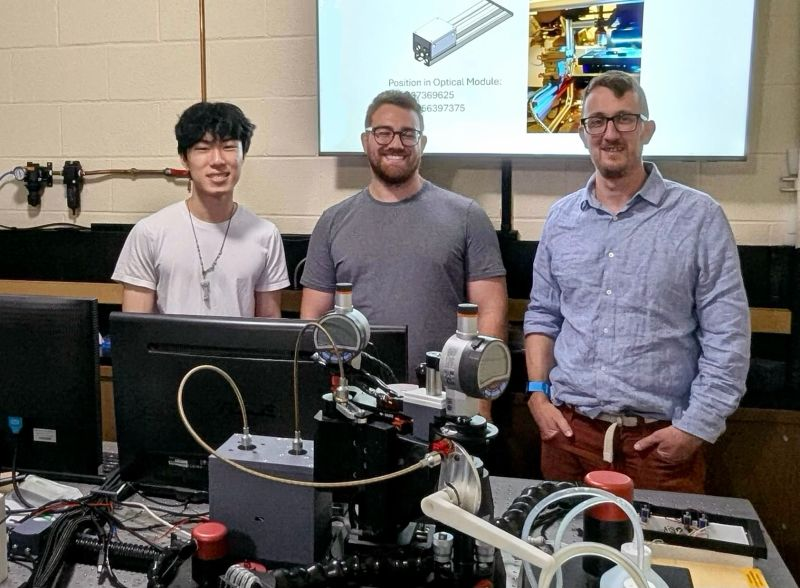
Channing Chen, Graeme Francolini and Dr. Ben Britton in the Electron Microscopy Laboratory
With Graeme Francolini and Dr. Ben Britton in the lab on the project's last day. The work was funded by an NSERC Undergraduate Student Research Award.
02

Driver Interface Enclosure

Mechanical design · CAD · Design for manufacture — UBC Formula Electric (FSAE), 2025–26

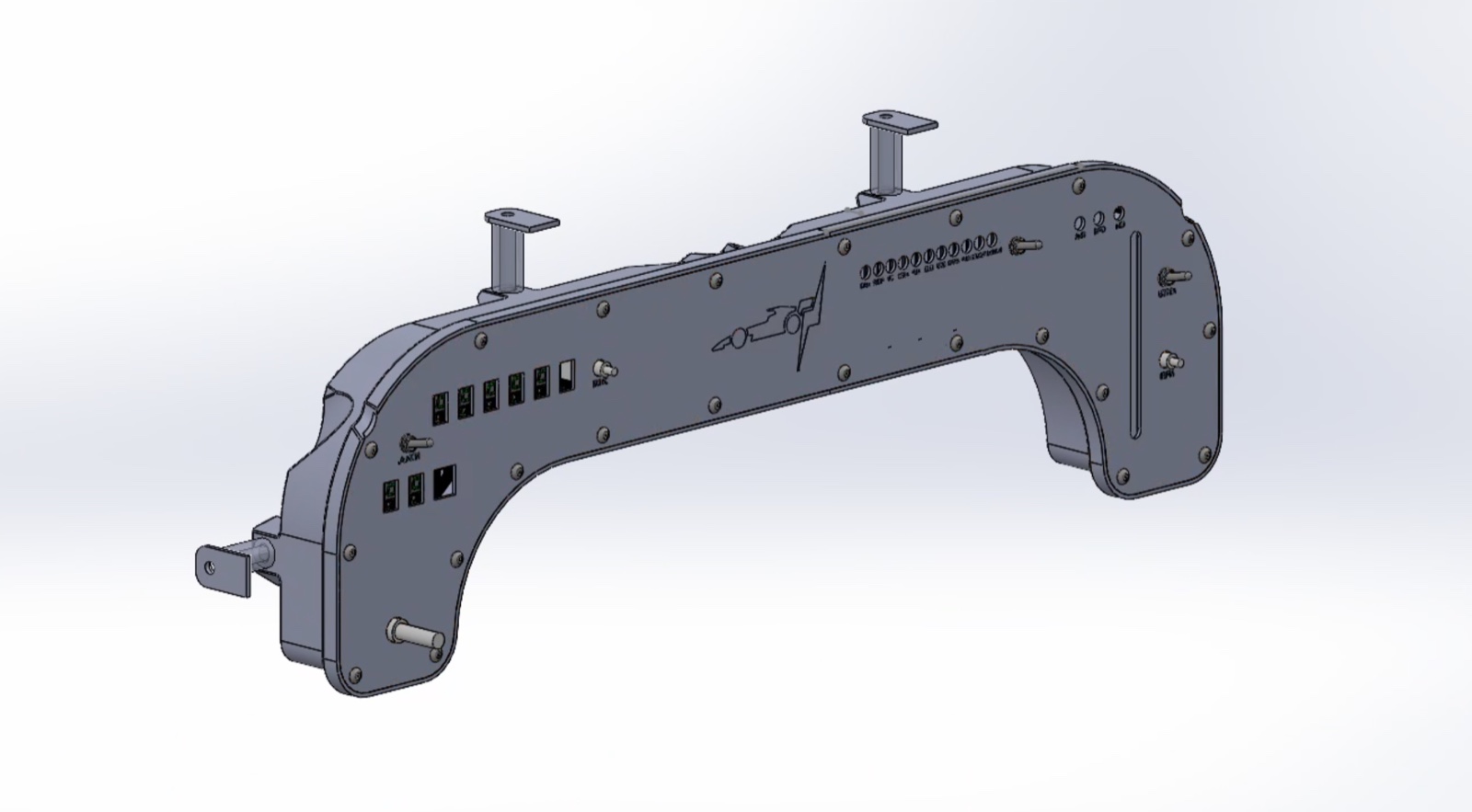
SolidWorks model of the V6.0 pDIM dashboard enclosure, showing the arched profile, switch and LED cutouts, and mounting tabs
The V6.0 pDIM enclosure in SolidWorks. The arch clears the chassis tubing; the tabs above and below locate it against the front hoop.

The pDIM enclosure houses the Driver Interface Module — the dashboard sitting directly in front of the steering wheel, and the driver's main instrument while the car is running. My job on the chassis sub-team was to design the housing that protects those electronics from water and impact without getting in the way of the person using them.

For V6.0 we widened the enclosure to span the full length of the front hoop, which bought ergonomics and internal space. It also made the part larger than the print bed on UBC's 3D printer. Rather than compromise the width, I split the enclosure into left and right halves that join to form the finished assembly — a manufacturing constraint driving the part architecture rather than the other way around.

Most of the detail work was in how it mounts and seals. Extruded cuts at the centre and sides clear the chassis tubes with a 1 mm tolerance, and 25 mm plastic spacers sit between the mounting tabs and the enclosure tabs. Every enclosure tab except the middle one is a slot rather than a hole, so the part locates precisely at one point and is free to take up tolerance everywhere else instead of being overconstrained and fighting the frame.

Inside, I added separators between the LEDs to stop light bleeding from one indicator into its neighbour; the vertical LED strip is left open and covered by a diffuser instead, since there the blend is the point. The enclosure had to reach an IPX5 rating — surviving water jets from a 6.3 mm nozzle at any angle — and, because it encloses part of the tractive system, carry the ISO 7010-W012 high-voltage marking required by the rules.

The enclosure sits directly over boards the electrical sub-team was revising in parallel, so the cutouts for displays, switches and connectors had to track their layout as it changed. We worked through Altium CoDesigner and Subversion, which kept mechanical and electrical revisions moving together rather than colliding at integration.

Tools

SolidWorks · Altium CoDesigner · Subversion · 3-D printing · FSAE rules compliance

03

BC Adolescent Health Survey Analysis

Data analysis · Survey methodology · Policy — McCreary Centre Society, 2023–25

I ran the statistical processing of the 2023 BC Adolescent Health Survey in IBM SPSS, working across a large provincial dataset to find the patterns underneath the summary numbers. Alongside that I worked with UBC researchers on the Middle Years Development Instrument, looking for places where the survey's data collection could be tightened.

The analysis ended somewhere most analysis doesn't: I presented policy recommendations to the BC Ministry of Education and Childcare, arguing for specific improvements to provincial school food programs.

Tools

IBM SPSS · Survey methodology · Root cause analysis